

What to do in Marrakech in 3 days: our favourite itinerary
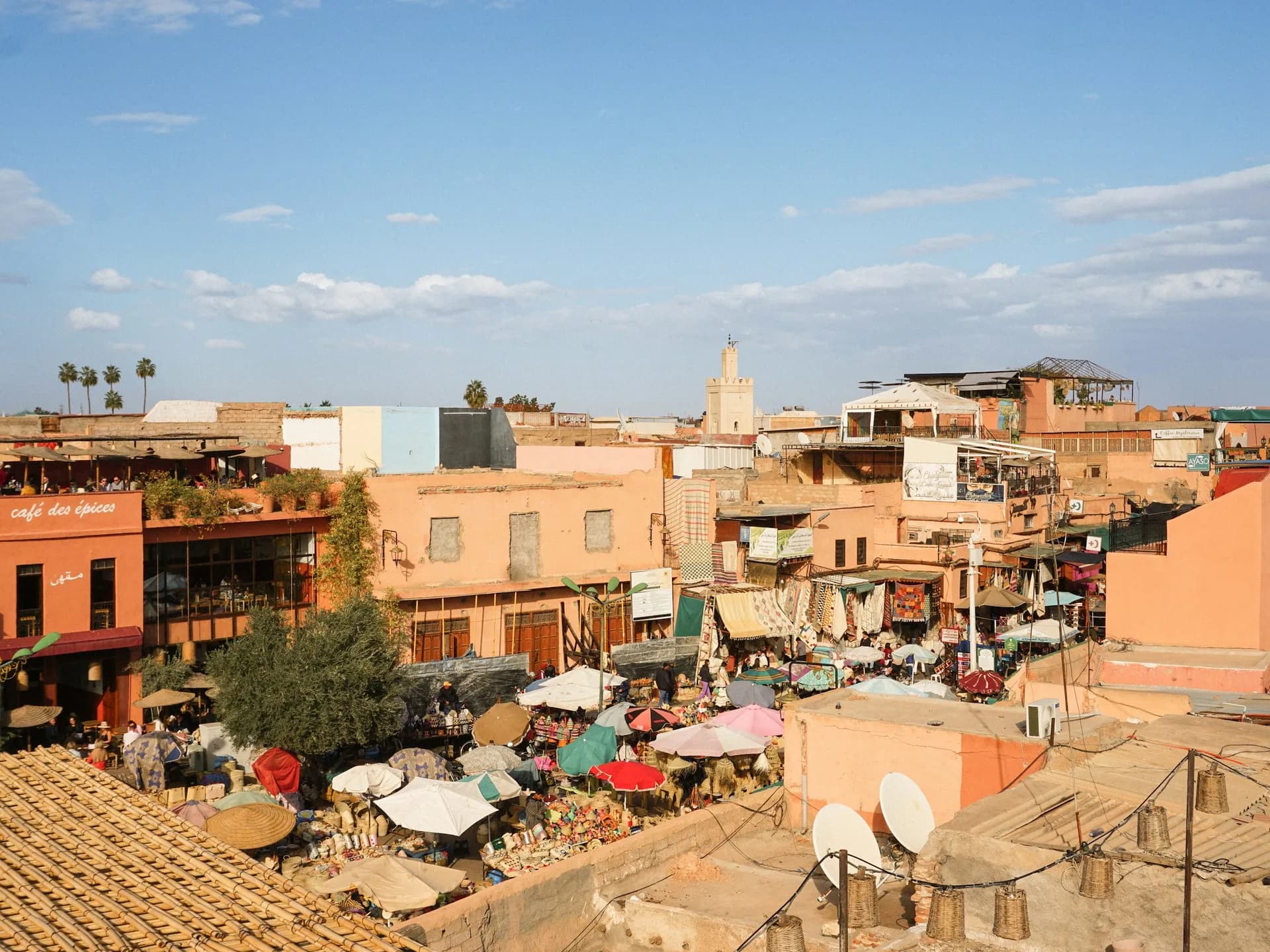
Three days are enough to see the essence of Marrakech, as long as you organise your time well. Between the lively medina, the hidden gardens and the rooftops at sunset, here is the itinerary we recommend most often to our guests.
Day 1: Into the northern medina
Devote your first day to the historic heart of the city, starting with the bustling area around the souks.
Morning — Souks and the spice square
Start early, while the souks are still quiet. Pass through Rahba Kedima, the spice square, before deliberately losing yourself in the surrounding lanes: the dyers' souk, the babouche souk, the coppersmiths' souk. Stop at Dar El Bacha, a former palace whose carved wooden ceilings and inner courtyards are well worth the detour.
Late morning — Ben Youssef Madrasa
This former Quranic school from the 16th century, one of the largest in North Africa, is considered one of the city's finest examples of Moorish architecture: zellige tilework, carved plaster and worked wood answer one another around a calming central courtyard. Bring cash for the entrance fee — card payment is generally not accepted.
Afternoon — Le Jardin Secret
For a shady break, head to this restored garden tucked into the very heart of the medina — a striking contrast with the bustle of the souks just a few metres away.
Evening — Jemaa el-Fna at nightfall
Jemaa el-Fna square transforms completely after 6pm: storytellers, musicians, food stalls. A nearby rooftop offers the best view to take in the buzz while you have dinner.
Day 2: Modern gardens and imperial palaces
Morning — Jardin Majorelle and the Yves Saint Laurent Museum
Book your tickets online in advance to skip the queue. The Majorelle blue and the cactus gardens are worth the trip on their own.
Midday — Lunch in Gueliz
Marrakech's modern district (Gueliz) offers more varied food than the medina, from reinvented Moroccan restaurants to international addresses.
Afternoon — Kasbah: Bahia Palace, El Badi ruins and ramparts
Head to the south of the medina to admire the ornate ceilings of the Bahia Palace, then climb the ramparts of the El Badi Palace, now in ruins but still impressive. Finish with the Saadian Tombs, ideally in the late afternoon: the golden light of that hour shows off their mosaics particularly well.
Evening — Time to unwind: hammam
After two days of walking, a traditional hammam is the best way to recover. It is also a cultural experience in its own right, worth doing at least once during your stay.
Day 3: Excursion or deeper exploration
For this last day, you have two options depending on what you feel like.
Option 1 — A day trip
The Ourika Valley or the Atlas Mountains are less than an hour's drive away and offer a real contrast with the city's bustle: waterfalls, Berber villages, fresh mountain air.
Option 2 — A deeper dive into the medina
If you would rather stay in town, take the chance to explore the less touristy quarters such as Bab Doukkala, or make time for a Moroccan cooking class to take a few recipes home with you.
Evening — One last sunset
End your stay on a terrace, mint tea in hand, watching the storks that nest on the city's ramparts and minarets.
Why stay in a riad in the medina rather than elsewhere
With an itinerary like this one, where you sleep matters a great deal. A hotel in Gueliz or on the outskirts means taking a taxi several times a day to get to and from the medina, where nearly everything worth seeing actually is. The result: wasted time, repeated journeys, and a city you pass through more than you live in.
A riad in the heart of the medina turns that logic on its head:
- Everything is within walking distance — souks, Jemaa el-Fna, museums, madrasas: no transport needed for most visits.
- You enjoy the medina in the evening too, without having to get back on the road once night falls.
- The calm-versus-bustle contrast is exactly what makes the experience memorable: you leave the buzz of the souks and, a few steps later, find the silence of an inner courtyard.
- It is often more affordable than a comparable upmarket hotel outside the medina, for a far more authentic setting.
In short: sleeping in the medina is not only a matter of charm — it is also the most practical way to make the most of a short stay like this one.
Practical tips
- Getting around: the medina is explored mainly on foot; for Gueliz or excursions, a taxi or a car with a driver is simpler.
- Best time to visit: favour spring (March–May) or autumn (September–November), when temperatures stay comfortable for walking all day.
- Budget: carry cash (dirhams) for some monument entrance fees, which are still rarely set up for card payment.
Planning your stay in Marrakech? Riad Coco is a few steps from the Ben Youssef Madrasa, one of the city's most beautiful architectural highlights — an ideal base for reaching most of the places on this itinerary on foot. We would be delighted to advise you on your stay.